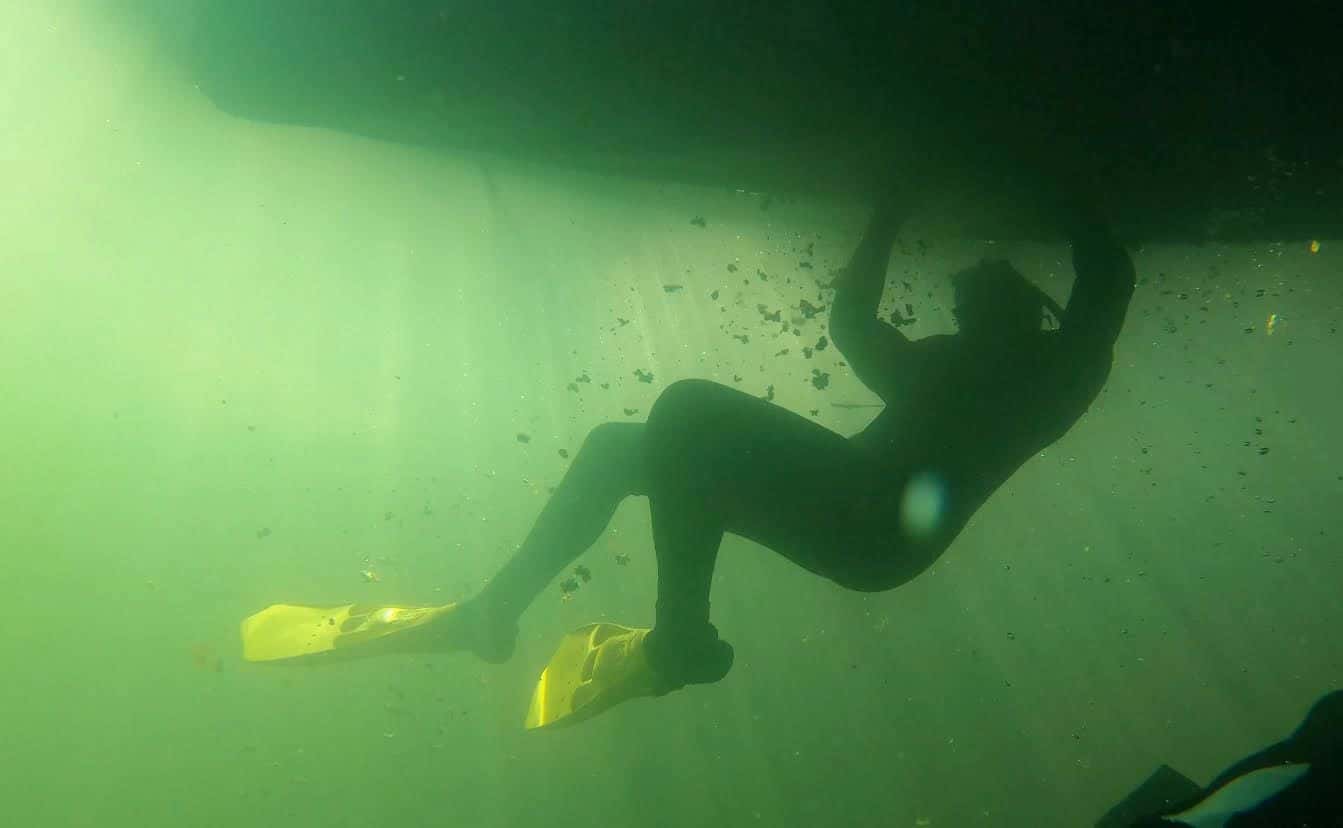
Cavitation cleaning removes growth with vapour bubbles that implode against the surface, at far lower pressure than a pressure washer and without a blade touching the paint. Pressure washing in or over the water and underwater scraping are the two practices Florida's Clean Marina program tells marinas to prohibit, and brushes do little against barnacles while wearing soft paint away. That is why every hull, prop, piling and seawall we clean is done with Ultra-Cavitation.
How does cavitation cleaning work?
A cavitation unit pushes water through a nozzle in a way that makes the pressure drop and vapour bubbles form. When those bubbles reach the surface they collapse in milliseconds, and the tiny shock waves from each implosion separate growth from whatever it is stuck to. Nothing hard touches the hull, no chemicals are used, and the cavitating stream is far less dense than a pressure jet, so the force on the diver's arm is comparable to holding a cup of coffee.
Industry write-ups on cavitation cleaning describe the same trade-offs we see every day: it removes fouling without damage to sound paint when used correctly, it releases fewer particles into the water than scraping, and it is safe for the diver. The one caveat is real and worth knowing: held too close or too long, a cavitation tool can wear ablative and self-polishing coatings. Standoff and dwell are diver skill, which is why our divers train for months before working alone, and why photos come with every cleaning. The full explanation is on our cavitation cleaning page.
Cavitation, pressure washing, scraping and brushes compared
| Method | How it removes growth | Effect on paint and gelcoat | In-water use in Florida |
|---|---|---|---|
| Ultra-Cavitation | Imploding vapour bubbles lift growth off the surface | Non-abrasive on paint and gelcoat at the right standoff; no blade contact | What we use on every job |
| Pressure washing | A dense high-pressure jet blasts growth and paint alike | Strips antifouling and can damage gelcoat and wood fibres | Clean Marina BMPs: prohibit in or over the water |
| Scraping (metal blades, chisels, pickaxes) | Mechanical prying | Removes paint, gouges gelcoat, wood and concrete, leaves barnacle base plates | Clean Marina BMPs: avoid; not authorised in mooring fields |
| Brushes and pads | Abrasion | Coarse pads scrub soft paint away; useless against hardened barnacles | Allowed, but limited to soft growth |
How the four methods compare (Florida DEP Clean Marina best practices and industry sources below).
Practical Sailor's bottom-paint guidance sums up brushes bluntly: they do not remove significant soft growth, they quickly scrub away too much soft paint, and they are useless against barnacles. Scrapers are the other extreme: they get the barnacles off and take the paint, and often the gelcoat, with them.
What does Florida's Clean Marina program say about in-water cleaning?
The Florida Department of Environmental Protection runs the Clean Marina program, a voluntary designation with a published best-management-practices manual (2020 edition). Its hull-maintenance section tells marinas to prohibit pressure washing for boat cleaning in or over the water, to encourage sponges or soft towels for regular underwater hull cleaning, and to avoid in-the-water hull scraping and any abrasive process underwater that may remove antifouling paint. The marina checklist repeats it as one item: prohibit in-water pressure washing and hull scraping. In mooring fields, hull scraping and painting are not authorised at all.
Read that list against the table above and the case for cavitation makes itself: no pressure washing in the water, no scraping paint off, and growth lifted rather than ground away. When a dockmaster asks what we do under their boats, that is the answer. For marina vendor rules, manatee season and the copper-paint question, see our in-water hull cleaning rules guide.
Is cavitation safe on wood pilings, concrete and seawalls?
Yes, and it is the reason we can say no pickaxes or chisels on a dock cleaning. Cavitation clears barnacles and oysters from steel, concrete, wood, rubber and fibreglass without damaging the surface or its coating. On a wooden piling that matters twice: a chisel opens the wood to marine borers, and a pressure washer tears the fibres. On a seawall, oyster growth comes off cleanly enough that cracks and voids can be seen and photographed, which is why our seawall inspections start with the cleaning.
Why does the method matter more than the schedule?
- Paint life. Every Florida owner thread we read agrees: gentle, frequent cleaning stretches a paint job; hard, infrequent cleaning ends it. A typical South Florida paint job lasts 18 to 24 months when it is treated well.
- Running gear. Props, shafts and rudders have no paint to protect them and foul first. Cavitation cleans metal without scoring it; a scraper leaves marks that foul faster next time.
- What goes into the water. Cavitation releases less particulate than scraping and uses no chemicals, which is what a Clean Marina dockmaster is checking for.
- Proof. Because nothing is ground off, the after-photos show the paint as it is. You can compare them month to month on the dive report.