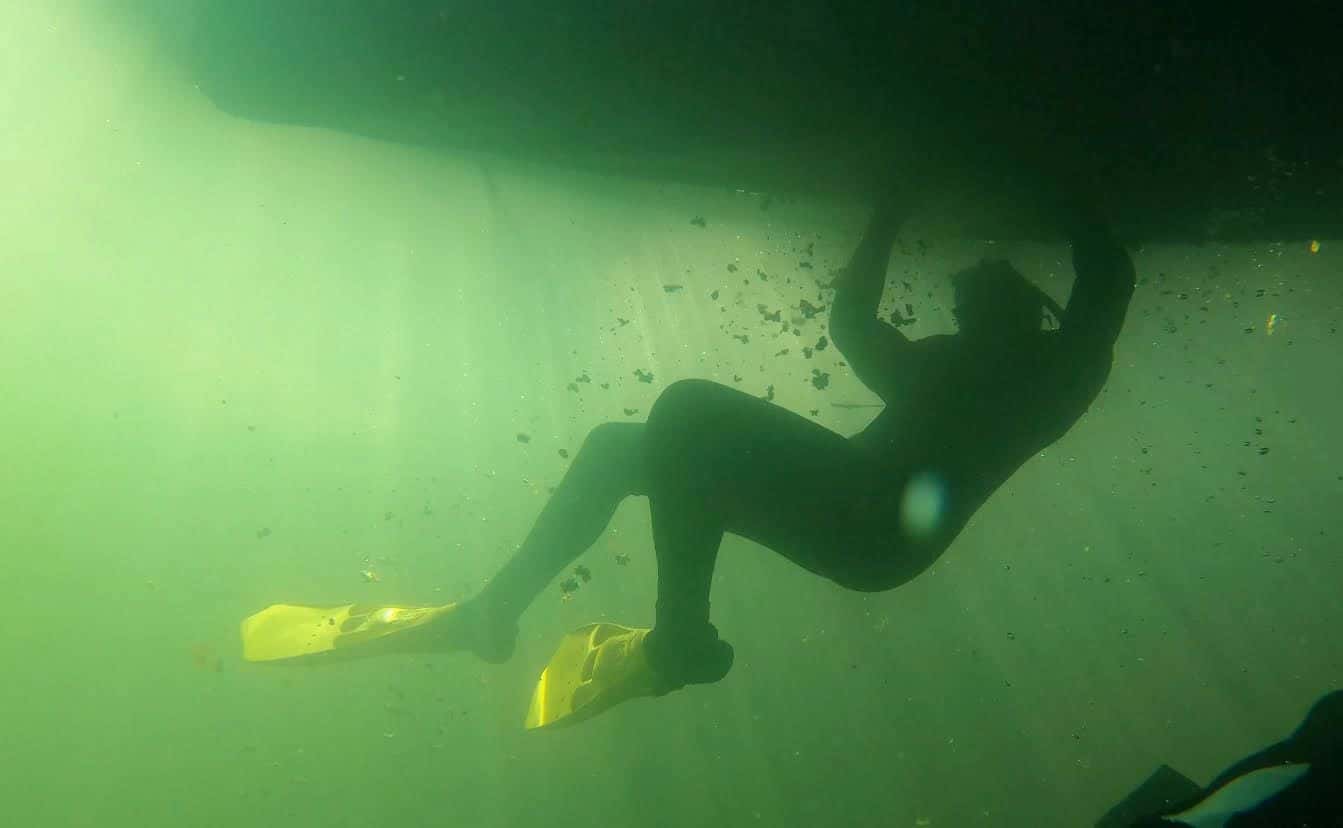
Zinc anodes protect your props, shafts, rudders, trim tabs and outdrive from galvanic corrosion by corroding first. Replace them at about 50% depletion or when they wear unevenly; in South Florida salt water that is anywhere from 3 to 13 months depending on the electrolysis around your dock, which is why we check every anode on every monthly dive and swap it at 50% instead of guessing. An anode that goes from full to half in a month is usually a stray-current problem, not a zinc problem.
What is galvanic corrosion, and what do zincs actually protect?
Put two different metals in salt water and connect them electrically, and you have a battery. The less noble metal gives up electrons and dissolves; the more noble one is protected. On a boat the bronze prop, the stainless shaft, the aluminium outdrive and the copper in the bottom paint are all connected through the hull and the bonding system, so something is always corroding. A sacrificial anode is a lump of metal chosen to be less noble than anything else on the boat, so it corrodes first and the running gear does not.
That is the whole job. Zincs protect props, shafts, rudders, trim tabs, struts, outdrives and, through the bonding system, thru-hulls and other underwater metal. When the anode is gone the next-least-noble metal in the circuit starts dissolving, and on most boats that is a prop or an outdrive that costs many times more than a year of anodes.
When should zinc anodes be replaced? The 50% rule
Replace an anode when it is about half gone, or sooner if it is wearing unevenly or has stopped making good metal-to-metal contact. Marine retailers' anode guides and corrosion-prevention advisories agree on the 50% figure: below half, the anode's surface area is too small to protect everything it is bonded to, and the risk shifts to the gear it was guarding. In salt water they recommend checking anodes every one to three months.
We check more often than that because we are already there. Every monthly hull cleaning includes an inspection of each anode, the percentage goes on the dive report, and anything at or below 50% is replaced. You see the trend month by month rather than discovering a bare stud at the next haul-out. Our zinc replacement page covers what the service includes.
How long do zincs last in South Florida?
Outside sources put a typical South Florida anode at six to twelve months, with checks every one to three months. Our own experience is three to thirteen months depending on the electrolysis at the dock. Both ranges are wide for the same reason: the life of an anode depends far more on the dock than on the boat. Warm, salty, well-connected water and a neighbour's leaky shore-power cord will empty a set of zincs in three months; a quiet private dock with a galvanic isolator may see the same set last a year or a little more.
That is why a date-based replacement schedule is the wrong tool. Percentage on every visit is the right one.
Why are my zincs disappearing so fast?
Normal galvanic corrosion is slow. When anodes vanish in weeks, look for stray current: a DC fault on your boat, a fault on a neighbouring boat, or a miswired shore-power connection that turns the marina's ground into part of the circuit. Stray current eats anodes far faster than galvanic action and, once the anodes are gone, eats running gear at the same pace.
- Galvanic isolator. Fitted in the shore-power cord's ground, it blocks low-voltage galvanic current from other boats while keeping the safety ground intact. Marina boats without one share their neighbours' corrosion.
- A hanging ("guppy") anode. Dropped over the side and clipped to the bonding system, it adds surface area at a marina berth.
- Check the neighbours. A boat two slips down with a wiring fault can drain your anodes; corrosion surveys in marinas routinely trace it to someone else's cord.
- Read the report. If an anode goes from 90% to 40% in a month on our dive report, that is a wiring problem, not a zinc problem, and we tell you.
Zinc, aluminium or magnesium anodes?
| Anode metal | Use it in | Notes |
|---|---|---|
| Zinc | Salt water | The traditional choice; performs poorly in fresh water |
| Aluminium | Salt and brackish water | Lighter, lasts longer per pound, works in brackish water |
| Magnesium | Fresh water only | Too active for salt water; it would be consumed in weeks |
Which anode metal for which water (marine retailer anode guides, sources below).
Most of our coast is salt water, so zinc or aluminium is the answer at the dock. Boats kept where fresh water enters the lagoon or river, near the C-51 canal in West Palm Beach or the Loxahatchee in Jupiter for instance, sit in brackish water where aluminium can make sense. Do not mix metals on one boat without a reason, and never use magnesium in salt water.
What does the dive report tell me about my anodes?
Every monthly report lists each anode and its remaining percentage, alongside bottom-paint condition and photos of the hull and running gear. Over a few months that becomes a corrosion history for your slip: a steady decline is normal, a sudden drop points at wiring, and a set that never moves may mean an anode that is painted over or not bonded. Replacement at 50% happens on the same dive, so there is no second visit to book.