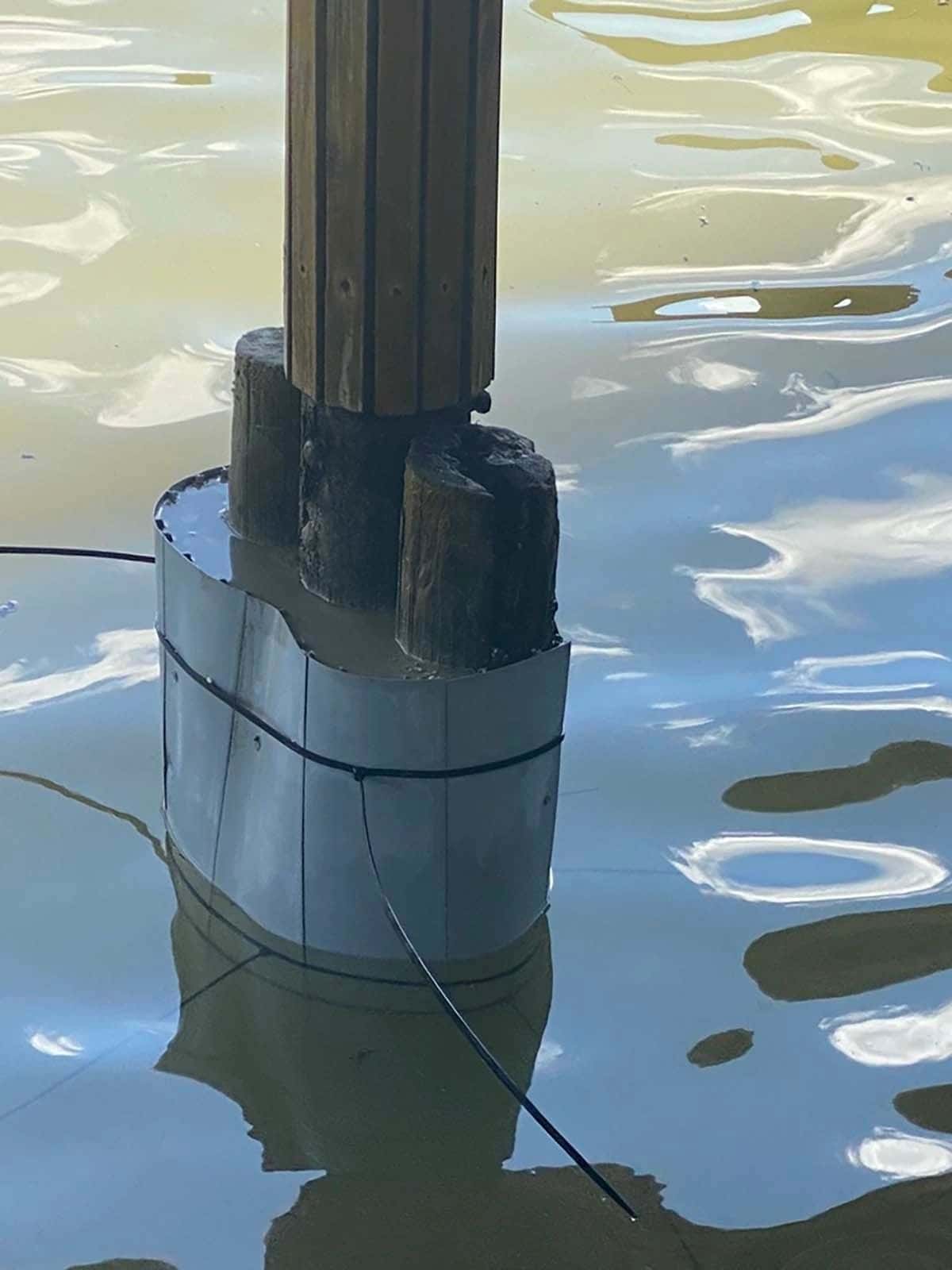
Shipworms and rot work from the inside, so a piling can look fine and be hollow. Probe it at the waterline with a screwdriver: if the tip sinks in, the piling is compromised. A sound piling gets an HDPE wrap from the mudline to two feet above high tide, which cuts off the borers; a hollowed, warped or broken piling gets a Snap Jacket, a PVC form snapped around the pile and filled with concrete that kills the borers and restores the pile without pulling it; only a piling too far gone for a sleeve gets replaced.
What is eating my dock pilings?
Mostly shipworms. Teredo navalis is not a worm but a bivalve clam that bores into wood as a larva and spends its life tunnelling through it. The entry hole is no bigger than a nail head; inside, a mature shipworm can exceed a foot in length and the piling is honeycombed. In warm, high-salinity water like ours, unprotected wood shows significant structural damage in three to seven years, and untreated pilings in Gulf and Florida waters can be attacked within a month of going in.
Oysters and barnacles do the rest. Their shells trap moisture and salt against the wood and against steel hardware, which rots one and corrodes the other; on concrete, barnacle adhesion stresses the surface and widens micro-cracks toward the rebar. Heavy growth also hides all of it, which is why our dock cleaning ends with an inspection rather than starting with one.
How do I tell if a piling is rotten? The screwdriver test
- Probe at the waterline. Press a screwdriver or awl into the piling where the tide line sits. Sound wood resists; soft wood or a tip that sinks in means borers or rot.
- Look for pinholes. Clusters of tiny holes are shipworm entries. The damage inside is far larger than the holes suggest.
- Look for splits and hourglassing. A piling that has narrowed at the waterline is being eaten from the outside; one that has split is losing its core.
- Check under old wraps. Borer damage at the waterline hidden under a failed wrap is the most common failure contractors find after storms.
- Check the lean. A piling that moves when you push the dock, or leans, has lost its footing at the mudline.
On a cleaning visit our divers do this below the waterline as well, where the mudline damage lives, and the multi-point inspection tells you which pilings are sound, which need a wrap and which need a sleeve.
How long do wooden pilings last in South Florida?
It depends on treatment and protection more than on age. Treated timber pilings that are maintained can last decades; unprotected wood in warm salt water can fail in years. In our experience, unwrapped wooden pilings on South Florida canals often need help after 10 to 15 years, which is why we wrap sound pilings early rather than waiting for the screwdriver to sink in.
Wrap, Snap Jacket or replace?
| Option | When it is right | What it does | Life |
|---|---|---|---|
| HDPE piling wrap | The piling is still sound | Black UV-stabilised HDPE sheet, 316 stainless nails, from the mudline to 2 ft above high tide; cuts off oxygen and water flow so borers cannot live | Properly applied wraps protect for 25+ years; we say at least 20 more years on the piling |
| Snap Jacket concrete sleeve | The piling is hollowed, warped, damaged or even separated | A UV-protected PVC jacket snaps around the pile in place, sand is blown out, a locking strip closes it, and the void is filled with concrete; the concrete kills the borers and restores the pile to more than its original strength | Manufacturer warranty of 25 years |
| Replacement | Nothing is left to sleeve, or the dock itself is being rebuilt | The old pile is pulled and a new wood or concrete pile driven, usually with a barge | New piling; the same borers start on it the day it goes in unless it is wrapped |
Wrap vs Snap Jacket vs replacement.
The order matters. A wrap on a piling that is already hollow seals in the problem; a sleeve on a sound piling is money you did not need to spend. The inspection decides. Our piling wrapping and Snap Jacket pages cover each in detail.
How does a Snap Jacket work, and why does it beat pulling the piling?
SnapJacket is a manufactured PVC jacket made in 10, 12, 14 and 16-inch diameters, chosen to leave at least an inch and a half of space around the existing pile. The diver cuts it to length, snaps it around the piling under the dock, blows the sand out of the annulus, slides the locking strip down, and the void is filled with concrete. No deck comes off and no barge is needed, which is what makes it cost-friendly next to driving a new pile. The concrete kills every borer in the wood and, once cured, the sleeved piling is stronger than the original.
It works on pilings from slightly warped to completely separated, which is the range where replacement used to be the only answer. Our installations on South Florida docks, boathouses and boardwalks are in the gallery on the Snap Jacket page.
What do piling wraps, Snap Jackets and replacement cost?
Market ranges from public sources, not Barnacle Doctor prices.
| Work | Published market range |
|---|---|
| Piling wrap, per linear foot | About $15 to $35 |
| Piling wrap, per piling installed (coastal) | About $90 to $420 depending on size and source |
| Piling wrap project total (national cost guide) | $900 to $8,400, average about $3,800 |
| Snap Jacket, per piling installed (owner forum reports) | Around $500 |
| Replacement piling, driven (forum and cost-guide reports) | $1,000 to $3,000 per piling; wood $20 to $40 per linear foot installed, concrete $50 to $80 |
| Permits where required | $150 to $500 |
Market figures from national cost guides and owner forums (sources below). These are not Barnacle Doctor prices.
Those are other people's numbers, published so you can see the shape of the decision: a wrap costs a fraction of a replacement, a sleeve costs a fraction of a replacement and saves a piling a wrap cannot, and every option is cheaper than losing the dock in a storm. Our own wrap and Snap Jacket work is quoted on the number of pilings, their size and condition and where the dock is. Send photos and we will quote it.
Do I need a permit to wrap or sleeve a piling?
It depends on the city and the county. Wrapping an existing piling is maintenance in most places. A concrete sleeve adds to the pile's footprint, and Miami-Dade DERM's Class I permits cover work in tidal waters, so the answer is not the same in Coral Gables as in Jupiter. We check what your city requires before the work is scheduled rather than promising there is no permit.