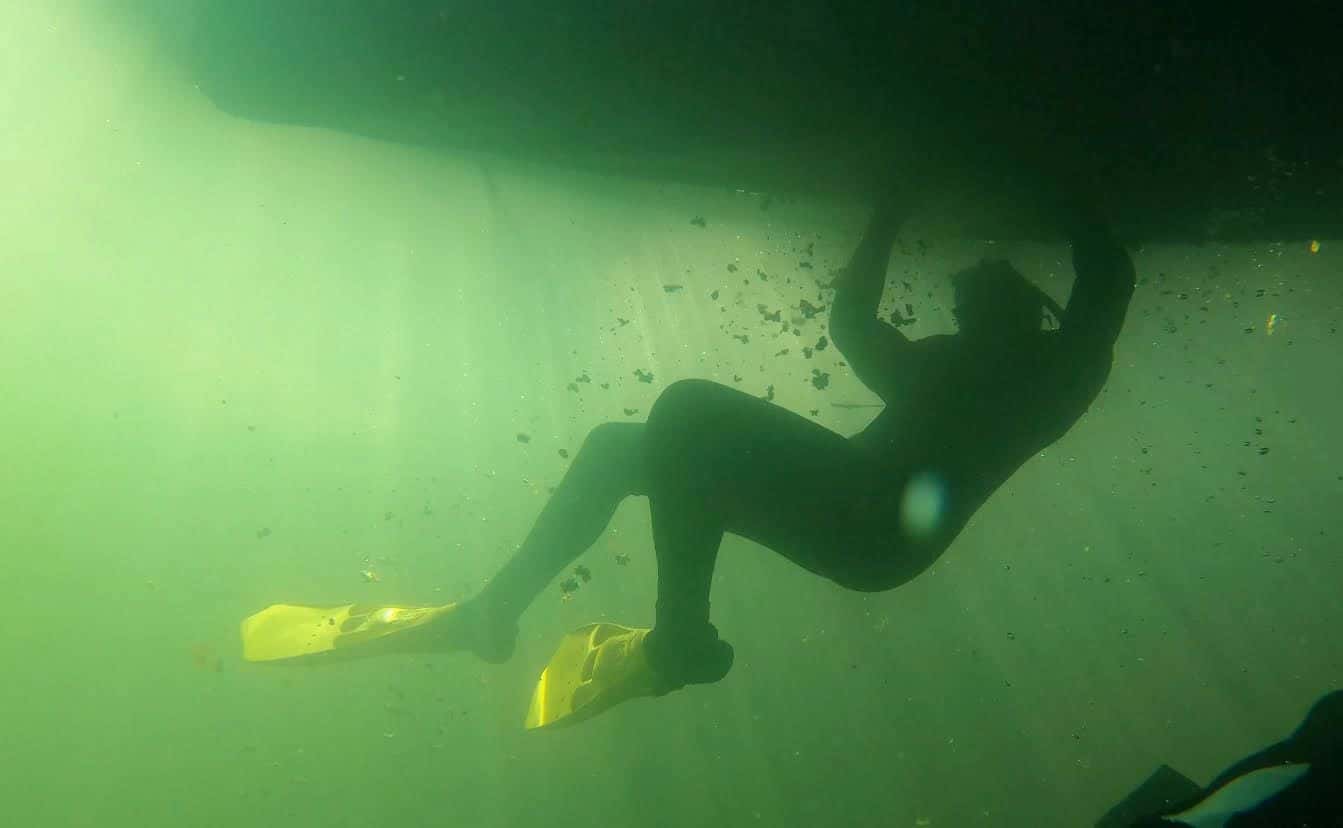
Clean a painted hull every 30 days if the boat stays in the water, and every two weeks if the hull has no bottom paint or sits in nutrient-rich water. That is the schedule Barnacle Doctor runs on, and the divers, yacht managers and forum threads we checked for this guide all land between three and six weeks for South Florida.
Why is 30 days the right interval for a painted hull here?
Growth in South Florida never stops. There is no winter die-off: the Gulf Stream keeps the water warm year-round, so slime forms within days and barnacles and tubeworms settle on top of it within one to two weeks of the last cleaning in summer. After 30 days the layer is still soft. It comes off with the lightest touch, which is the whole point: the softer the growth, the gentler the tool, and the longer your bottom paint lasts.
Wait 60 or 90 days and the picture changes. Barnacles have hardened, their base plates have bonded to the paint, and removing them means harder scrubbing that takes paint with it. Boaters on The Hull Truth and Practical Sailor's bottom-paint guidance say the same thing from the owner's side: frequent, gentle wiping extends paint life; infrequent, aggressive cleaning strips it.
Our own rule follows from that. Every 30 days the diver cleans the hull, running gear and waterline with non-abrasive cavitation, checks the zincs and sends photos and a dive report. You do not need to be there; the monthly plan runs on a schedule.
When should a boat be cleaned every two weeks?
- No bottom paint. Barnacles adhere to bare gelcoat faster and thicker than to antifouling paint, and left long enough they blister the gelcoat. We put unpainted hulls on a two-week schedule; other local plan pages use 10 to 14 days for the same reason.
- Nutrient-rich water. Still, shallow, poorly flushed canals and no-wake basins grow more, faster. Boats near an inlet get flushed with cleaner ocean water and foul more slowly than boats deep in a finger canal.
- Running gear that matters. Bottom paint does not hold on metal, so props, shafts, rudders and trim tabs foul first. A boat that runs hard every weekend may want a two-week running-gear check even if the hull is fine at 30 days.
What do other South Florida sources recommend?
We checked what is published locally so you can see the range for yourself. None of it argues for waiting longer than six weeks in summer.
| Who | Recommended interval |
|---|---|
| Barnacle Doctor | 30 days painted hull; 2 weeks bare gelcoat or nutrient-rich water |
| South Florida yacht-management company (2023 article) | 3 to 4 week rotation; summer is "an incubator" |
| Local dive-service plan pages (2026) | 4 weeks default for a painted hull; 10 to 14 days bare gelcoat; 4 to 6 weeks May to October, 6 to 8 in winter; "most boats every 3 to 4 weeks" |
| The Hull Truth, Trawler Forum, Cruisers Forum threads | Owners in South Florida report monthly divers as the norm, some stretching to 6 weeks in winter |
Published intervals for South Florida (sources at the bottom of this page).
Does the season change the schedule?
Less than you would hope. Water temperature in South Florida stays warm enough for barnacle larvae to settle all year, which is why local divers say there is no true slow season. Growth is fastest from late spring through October, when a hull can show new barnacles two weeks after a cleaning; it slows a little from December to February but does not stop. We keep the 30-day rhythm year-round because the winter savings from stretching to six weeks are small, and the cost of a hardened summer layer is not.
What if my boat lives in a canal or on the Intracoastal?
Location is the biggest variable after paint. Fort Lauderdale alone has more than 165 miles of waterways, and the finger canals off the New River and the Middle River do not flush the way an inlet does. Warm, shallow, slow-moving water with runoff is where we see the heaviest growth, which is why boats in Las Olas Isles, the Venetian Isles in Lighthouse Point or the Cocoplum canals in Coral Gables tend to need the full 30-day interval or shorter, while a boat kept near Hillsboro, Boynton or Government Cut often looks cleaner at the same age.
Current does not save you either. Barnacles are filter feeders, so a slip with steady flow delivers food and can mean heavier growth, not lighter. The honest answer is that we set the interval after the first dive, when the diver has seen your slip.
My boat is on a lift. Do I still need a diver?
A hull that comes out of the water every time does not foul. What does foul is everything on the lift that stays wet: the beams, cables, bunks and, on a hydro-hoist, the whole tank, because it sits fully submerged. Growth on lift wheels and bunks scrapes the boat every time you load it, and barnacles can cut hydraulic lines. Lifts, floating docks and pilings go on an annual dock cleaning rotation rather than a monthly one.
What happens to a boat left in the water all summer?
Six unattended months in South Florida turn a bottom into a reef. Thru-hulls clog, which is how water makers, live wells and air-conditioning pumps die; running gear loses its coating; and the paint underneath a hardened layer is usually finished. If you leave for the summer, the answer is a schedule that runs without you: the diver comes every 30 days, the photos and the report reach you wherever you are, and billing is monthly. That is exactly what the monthly plan is for.